Vodafone Will Upgrade Its Networks to Improve Resilience
Vodafone plans to improve disaster resilience for more than 10,000 European mobile sites that are key for serving public safety and emergency services, as well as other key parts of its network infrastructure. The goal is to improve the ability of the network to function in the event of major regional or national incidents that interrupt the power supply. The upgrade programme is set to take two years, starting in Portugal, and includes strengthening of core regional and central sites as well as parts of the radio access network. For small, localized outages that affect just a small number of mobile sites, Vodafone will continue to use transportable mobile solutions.
These investments are a wise move to ensure Vodafone’s terrestrial network can withstand increasing climate-related events, power infrastructure instability and geopolitical risk, among other concerns. If Vodafone’s network can better support consumers and business users — as well as public safety and emergency workers — then perceptions of the Vodafone brand and customer retention will improve. FDM CCS Insight believes other operators should also now assess how to improve their network resilience given the changing global landscape.
Vodafone Aims to Boost Network Resilience with AI, Improved Power Backup and Satellite
To improve resilience, the central or core sites will be designed for either 72 hours of operation on backup power or the ability to run on generators with guaranteed refuelling within 48 hours. At major sites that connect areas of the access network, Vodafone will ensure there’s at least four hours of backup power — the precise time depends on traffic and load, and careful management may allow significantly longer operation.
In the radio access network, Vodafone has identified an initial set of 10,000 mobile base stations and backhaul sites that provide coverage for key emergency services locations, hospitals, command and control centres, government offices and major transport hubs such as stations or airports. This should be just an initial set of sites, because in any emergency, first responders will need connectivity wherever they are and not only at their base. Vodafone rightly sees this as the start of an ongoing upgrade programme.
Satellite-based direct-to-device connectivity bypasses the terrestrial network and can provide the ultimate backstop solution if the mobile network on the ground fails. Vodafone plans to use AST SpaceMobile’s system to support smartphone users. However, FDM CCS Insight expects the capacity of such satellite systems to be considerably lower than terrestrial cellular networks, and it won’t act as a full replacement, but will help in such emergency situations.
Rising Climate and Geopolitical Risks Make Resilience More Important
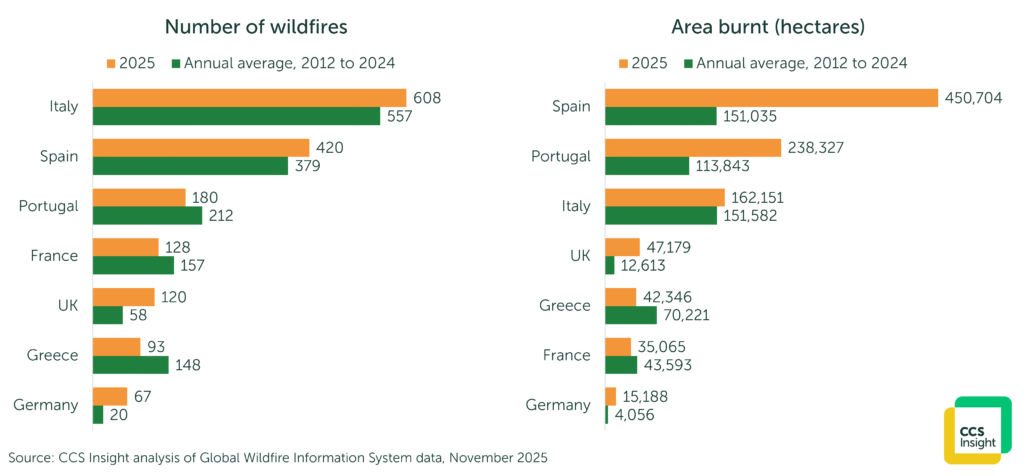
Portugal has a clear imminent need for greater robustness, because it has been particularly affected by wildfires in 2025. The country averaged 212 wildfires between 2012 and 2024 and, in 2025, it has had more than double the long-term average of burnt land area, with a staggering 238,327 hectares affected, representing 2.59% of the area of the country. Additionally, like Spain, Portugal suffered a major country-wide power outage in April 2025.
As the world is changing, all operators should be planning how to adjust their network deployments and management systems to respond. Autonomous solutions will be an important part of this change. There are several drivers for operators in Europe to improve their network resilience now:
- Rising threats from climate change. In the EU, there was an average of 106 wildfires per year per member country between 2012 and 2024. The impact is increasing: the total area burnt in 2025 to date is 29.3% higher than the 12-year average. Storms and flooding are also becoming more damaging.
- Ongoing earthquake risks in southern Europe. There are tectonic plate boundaries near or within southern Portugal, southern Spain, Malta, Italy and Greece. Typically, an earthquake will cause regional disruption to mobile networks.
- Power grid instability. With reduced usage of fossil fuels and rising investment in data centres to support AI, there’s increased demand for electricity. This is triggering modernization programmes to build smart electricity grids, as we analysed in The Grid of the Future: Lessons from Digitalization of Industries. These increased demands and different usage patterns risk triggering power outages, even in developed European markets.
- Evolving European cybersecurity and infrastructure protection framework. Multiple measures place new responsibilities on telecom operators. The EU’s NIS2 directive mandates actions to ensure continuity of key services. There are similar implications from the EU Cyber Resilience Act.
- Increased geopolitical concerns. Mobile networks are increasingly a core part of public safety services, which will be important in any future geopolitical crisis. In addition, there are growing military uses for mobile networks. For example, in June 2025, Orange created a new Defense and Homeland Security division. In March, Telia supported a Nordic military exercise with a secure 5G network slice that operated across international borders.
Using AI to Extend Operation
Simply installing larger, more-modern batteries isn’t a sufficient approach to improve network resilience in the event of power outages. Although more-modern lithium-ion batteries are more versatile than the old lead–acid batteries still used at many mobile sites, intelligent radio access site management can deliver further improvements.
In Greece, Vodafone reports that it has launched an AI-driven Adaptive Power Backup service. Trials are underway in Turkey, and Vodafone plans to extend them to further markets in 2026. FDM CCS Insight considers that this kind of approach has become an essential part of network management to improve reliability.
In the event of an outage, this adaptive power system automatically reduces the bands that are active and switches a site to a lower energy state. If the issue is small and local, then the system will attempt to maintain a reasonable quality of service for a period and continue to keep a range of bands live before reducing performance further to prioritize essential connectivity. Vodafone has tracked an approximate 63% improvement in operation time in this balanced mode compared with a traditional approach.
If the problem is regional or national, then the Vodafone operations team will mandate tighter control of resources to the affected sites in the country. For a regional issue, all non-essential bands will be quickly switched off, maintaining just one low-frequency band that maximizes coverage. Vodafone reports that this mode further boosts a site’s operation to 10.5 hours from six hours for the balanced mode and just 4.5 hours in a traditional set-up with the same battery.
In the event of a national outage, the system can be instructed by the operations team to act faster in tightening resource management. In that case, the system will autonomously adjust each site’s radio-frequency parameters to ensure mobile coverage by further boosting operation for up to 18 hours. This may include alternatively switching on and off nearby sites, so that each site’s battery backup only runs part of the time, prolonging the overall operation of the network but still maintaining a mobile signal over a wide area.
A challenge for Vodafone is to ensure it can implement these resiliency initiatives across its full range of suppliers. If only one mobile network equipment vendor is able to implement a solution, then sites with other suppliers would be left out. Like most operators, Vodafone typically has two radio access suppliers in each country. Across its European operations, Vodafone uses a range of network equipment manufacturers including Ericsson, Huawei, Nokia and Samsung Networks.
Using Mobile Sites to Improve Power Grid Robustness
In the future, there will be other possible uses for the upgraded mobile base station power infrastructure that Vodafone operating companies should target. The battery capacity at mobile stations can be used to stabilize and increase the robustness of the power grid, as well as ensure ongoing network performance.
Such virtual power plant (VPP) approaches can help to stabilize the frequency of the grid, if there are unusual usage patterns or if power generation fluctuates because of increased use of wind or solar power. Such frequency stabilization doesn’t require sizable amounts of spare battery capacity.
However, as more mobile base stations gain higher-capacity battery backup, there’s also the potential for those batteries to supply power back to the grid. The mobile network can, in effect, provide rapid reaction backup power to balance the electricity grid. In Finland, Elisa already has a VPP system provided by Nokia live on its network.
Vodafone is seeking to partner with other operators and electricity providers using a VPP approach. This requires the electricity market, mobile market regulation and governments to be ready. Within its footprint, Vodafone believes that Germany, Ireland and the UK are likely to be the earliest to invest in VPP.
Vodafone’s move to improve network resilience will have immediate benefits for each country and Vodafone’s customers. But such investments also open the potential for new revenue streams for mobile operators from the electricity industry.

 LinkedIn
 Email
Email
 Facebook
 X
X