
Curious But Cautious: What Consumers Really Think about AI
Generative AI is capturing attention and curiosity around the world. Tools like ChatGPT, Google Gemini and Microsoft Copilot are being put to the test by individuals at home and at work. People are using AI in all aspects of their lives, meaning tools can sometimes interact with personal or company information, so trust is more important than ever.
In our quarterly Pulse: Connected Consumer surveys, we ask over 5,000 people in the US, the UK, Germany, Spain and India about their awareness, usage and trust of AI services. This article provides a snapshot of the latest update’s preliminary findings. The results reveal a mixture of excitement, curiosity and caution. Many respondents are eager to explore AI, but awareness and trust vary widely depending on the company and region.
Awareness and Usage: ChatGPT Leads, But Momentum Is Building for Gemini and Copilot
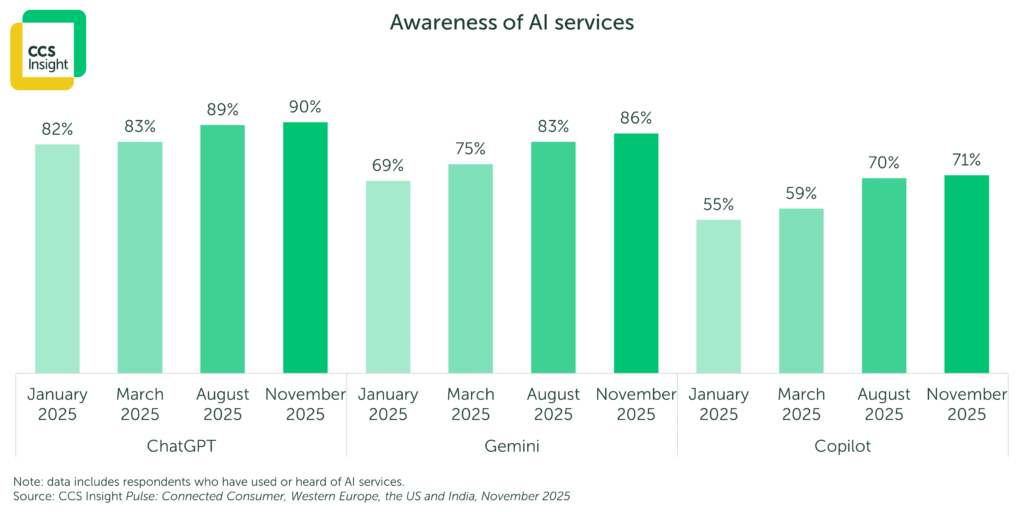
Awareness of major AI services is now near-universal. This is led by ChatGPT, which reached 90% awareness in our November 2025 survey. This reflects both extensive usage and a large proportion of people who have heard of the service, even if they haven’t used it. Gemini has also expanded rapidly, with awareness rising from 69% in January to 86% in November 2025, driven by increasing visibility in Google’s ecosystem. Copilot shows a similar upward trajectory, with awareness climbing from 55% to 71%, reflecting Microsoft’s continued integration of AI into workplace tools.
In contrast, less-established AI providers continue to face hurdles. Respondents are far less familiar with services such as Claude and Mistral AI, with over three-fifths of people saying they haven’t heard of them. This reinforces the structural advantage held by platforms embedded within large consumer and enterprise ecosystems.
Regional differences still shape the landscape. India stands out with particularly high awareness in all major platforms, followed by the US, where familiarity with AI services is strong. Europe shows slightly lower overall awareness, with Germany and the UK lagging Spain.
Trust: Familiarity Drives Confidence, But Scepticism Persists
Despite ChatGPT leading adoption, Google holds a notable advantage in terms of trust. Over 20% of respondents say they “completely trust” Google to offer AI services, compared with 18% for Microsoft and 17% for ChatGPT.
Established technology companies benefit from years of brand familiarity, so consumers are more comfortable with their AI offerings, whereas Meta, Xiaomi and emerging AI providers score significantly lower, often completely trusted by less than 10% of respondents.
Trust levels also show clear and consistent differences across markets. European respondents are notably more cautious, with Germany showing the greatest scepticism — only 13% completely trust Google, the most established of the major platforms. The level of trust among respondents in the UK sits slightly higher at 16%, and Spain shows marginally more confidence at 18%.
The US occupies a middle ground, with complete trust in Google at 22%. The gap between Google and its competitors is also wider in the US, at four to five percentage points, suggesting stronger brand differentiation.
However, India represents a different trust environment. Nearly half of respondents (46%) completely trust Google, more than double the US figure and more than triple that of Germany. This heightened trust extends to other platforms as well, with Microsoft and ChatGPT completely trusted by 36% and 38%, respectively. These findings suggest that, in emerging markets, established tech brands enjoy markedly higher credibility.
Regional Variations Highlight Cultural Differences
It’s fascinating to see the regional differences in use of AI in conversations and survey responses. In India, people seem to be embracing tools like ChatGPT, Gemini and Copilot in everyday life, and my friends are using them for everything from planning diets to travel itineraries or even asking for astrology advice. People in the US express curiosity mixed with caution: they’re excited to try AI, but trust and reliability are still on their minds. In Europe, privacy and confidence remain the top priorities.
AI is impressive, but trustworthiness matters just as much as capability. These tools are creeping into our routines, helping with work and hobbies. Whether we embrace them or hold back comes down to how reliable we find them. Watching friends and colleagues use AI in such creative ways makes me think we’re only scratching the surface of what’s possible.

 LinkedIn
 Email
Email
 Facebook
 X
X