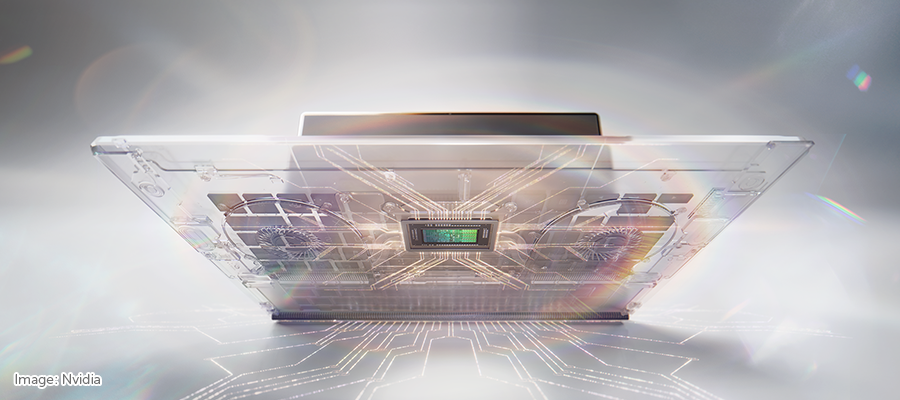
Nvidia Debuts RTX Spark Chip to Transform PC Market
At Computex 2026 in Taipei, Nvidia unveiled its RTX Spark silicon. Built on Nvidia’s Arm-based 20-core Grace CPU, which was developed in partnership with MediaTek, and the Blackwell RTX GPU architecture, the silicon aims to transform traditional computers into “AI PCs”, enabling significantly faster on-device processing.
Nvidia’s new chip enables large AI models to run directly on laptops and desktops rather than relying on cloud infrastructure. The initiative is supported by Nvidia’s collaboration with Microsoft and its OpenShell runtime, which introduces security and privacy controls for local AI execution. Data privacy remains a major concern for consumers and enterprises. Expanding on-device computing from smartphones to wearables and, now, PCs reflects moves to accelerate adoption of AI.
The most notable advancement is the chip’s support for up to 128 GB of unified memory and 1 petaflop (1,000 trillion operations per second) of AI computing power. Until now, this level of computing power and the memory to support it have largely been confined to AI data centres. In the long run, we believe people will be able to access data centre-level AI capabilities on personal devices.
That said, the evolution follows a familiar pattern in computing. Processing power first scaled through PCs, then expanded to smartphones and, more recently, to data centres. The next phase appears to be bringing that computing power back to devices, starting with PCs, enabling more-secure and efficient AI experiences.
Nvidia says the chip can handle large language models with 120 billion parameters, editing 12K video (80 million pixels per frame) and generating AI video locally, activities that typically require cloud services or expensive dedicated hardware. The platform is also targeted at high-performance gaming.
This isn’t the first attempt to bring AI features into PCs. In 2024, Intel, AMD and Microsoft launched a wave of Copilot+ AI-focused laptops that have largely failed to gain traction. The hardware is capable, but software support has lagged, and most features still depend on cloud resources. Nvidia claims to offer a more complete ecosystem that combines hardware, software optimization and developer support from the outset.
This is a major development in the Windows PC market that has so far lagged Apple in terms of edge-AI capabilities. Major PC-makers, including Asus, Dell, HP, Lenovo, Microsoft and MSI, plan to deploy the RTX Spark chip in devices later this year. In the gaming segment, Microsoft and Nvidia announced expanded access to Xbox gaming on RTX Spark devices. Software companies such as Adobe, Affinity, Blackmagic Design, Blender and Maxon are also optimizing their applications for the platform.
The launch will increase pressure on competitors. Nvidia forms a strong rival to Intel and AMD. Rather than competing on CPU benchmarks, Nvidia is harnessing its dominance in GPU and AI workloads from the data centre into the PC space.
Qualcomm’s position in Windows on Arm is also under threat. Although Qualcomm has focused on efficiency and battery life, Nvidia’s targeting of higher-performance AI systems, effectively splits the market into efficiency-focused and AI-focused devices.
Apple remains the closest architectural comparison. Apple’s Arm-based silicon has demonstrated the advantages of unified memory and tight integration of hardware and software. Nvidia is adopting a similar approach, but with AI workloads as the central focus rather than energy efficiency.
That said, the RTX Spark chip still has challenges ahead.
Software compatibility remains one of the biggest concerns. Windows on Arm has improved significantly, but many businesses still depend on older x86 applications. Nvidia says most Windows software will run well, but independent testing will be important.
Pricing is another unknown that could have a big impact on adoption. High performance alone isn’t enough if the devices are more expensive than people are willing to pay. We expect enterprises to be the primary early adopters of this technology, as premium pricing is likely to limit adoption among consumer segments.
For Nvidia, this move is unlikely to change its financial performance in the short term. Its data centre business is far larger than its PC business and is expected to remain so several quarters.
However, the launch is strategically important. The PC landscape is changing. Performance is no longer measured in CPU speeds or graphics performance. Increasingly, it’ll also be measured by how well a device can run AI locally, quickly and securely.
Whether the initiative succeeds will depend on more than the platform itself. It’ll rely on software, pricing, developer support and whether users find enough value in running AI directly on their own devices.

 LinkedIn
 Email
Email
 Facebook
 X
X