Preventing Digital Tasks from Feeling Like Obstacle Courses
Most frustrations with AI assistants come down to one thing: the task is rarely hard, but the path is messy. People bounce between apps, logins, pop-ups and inconsistent interfaces, and every extra step is another push to give up. That friction hits hardest for older users, people with disabilities and households where not everyone has the same digital confidence.
A cloud-based, operator-integrated AI assistant is a response to this everyday mess. By making an assistant less dependent on the device, firms enable a consistent service that can help people complete tasks across screens.
A solution should align with three core principles: remember a user across devices, handle more complex tasks, and do so in a way that feels safe.
Continuity Beats Cleverness
Continuity is a vital proposition. A unified assistant that carries context across personal and home environments means that users don’t have to start from scratch when they switch to a different device.
That matters because “device dependence” is one of the quiet drivers of uneven AI adoption. If advanced capabilities sit mainly on the newest hardware, you widen the gap between people who can benefit and those who can’t.
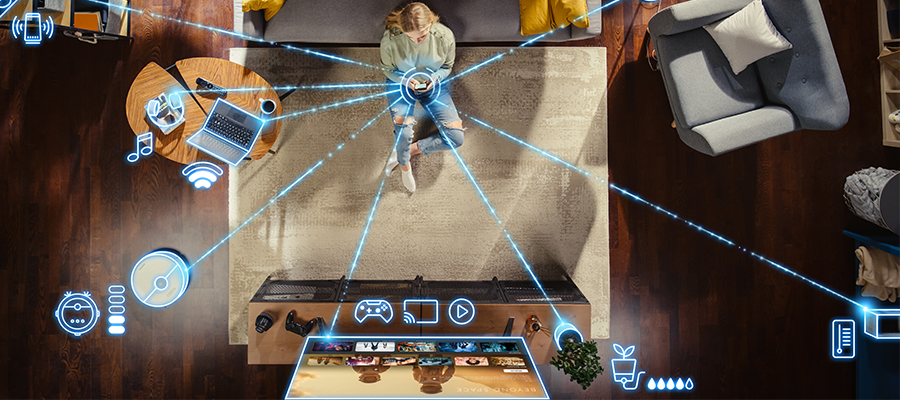
For example, China Unicom and Huawei’s Tone Tone assistant is designed to push intelligence into the cloud and deliver it as a single service across phones, TVs and home equipment, where connectivity allows.
Doing Beats Talking
AI assistants are the most useful when they move from describing what to do to actually getting things done, from narration to operation.
In a demonstration by Huawei and China Mobile, the Tone Tone agent carried out multistep tasks across apps using a graphical user interface (GUI) approach, including calling a taxi and stepping through a shopping flow.
Two small details mattered because they reflect real life, not a controlled demo environment:
- When an advert pop-up appeared, the agent recognized it as irrelevant, closed it and carried on. Anyone who has tried to automate consumer apps knows that pop-ups are often where smart ideas break down.
- The agent paused for user confirmation at payment rather than completing payment automatically. That boundary is a sensible design choice if the goal is to make automation feel safe and not pushy.
A limitation also surfaced, worth treating as product reality: at one point in the demo, English wasn’t understood. That isn’t unusual for early roll-outs, but it’s a reminder that an assistant’s usefulness is still shaped by language capabilities, not only by technical ambition.
What Sits Underneath the Experience
The Tone Tone assistant is built on an AI Service Function (AISF) layer, aiming to combine three core elements: continuity, through memory and profiling; speed, with fast recognition of a user’s intentions; and secure identity-linked operation.
Huawei and China Unicom describe a fast-path and slow-path approach to intent recognition that they claim reduces response time from seconds to milliseconds. They also cite improvements in understanding accuracy and multistep task success. Cross-device memory and profiling, including voice recognition in home settings to help distinguish between household members, are additional focus areas.
The companies present a coherent narrative about how the tool works: centralize intelligence so capability isn’t bound to the device, keep memory consistent across devices and use GUI operations to complete tasks even where formal integrations are limited. This reduces the need for users to navigate complex app journeys.
However, what will matter most to people is predictable behaviour. An AI assistant must reliably complete a task without clarifications, behave consistently when an app flow changes, and act responsibly when it can’t finish a job. A broader architecture road map should underpin this experience, including richer cross-device memory behaviour, more resilient task execution and tighter trust controls as capability expands.
Trust Must Be Visible
Once an assistant can act, trust becomes a must-have. Huawei and China Unicom lean on operator-grade identity assurance, with SIM-based digital identity binding, encryption and access controls intended to keep identity-linked operations traceable and controlled.
It’s notable that personal data isn’t stored on the SIM. Instead, the SIM is used to link the agent to a verified identity, while data is stored in an isolated manner and access is presented as consent-driven.
The broader AISF security posture is described as identity binding, encrypted transmission, isolated storage and permission controls to support consistent operation across devices.
However, trust is most tangible in terms of control. It would help to see, in plain terms, how permissions are granted and revoked in practice — per task, per app or per data type — and how easily a user can review, amend or delete what the assistant has remembered.
Home devices exacerbate this issue. TVs and shared screens are exactly where identity confusion can creep in unless the experience makes it easy and obvious to identify a user.
Ecosystem Is the Multiplier and the Next Test
An AI assistant becomes more valuable when it serves as a distribution layer for specialized services, rather than a fixed set of features.
Tone Tone isn’t positioned as a closed assistant. The idea of an “open framework” appears in the AISF narrative, with room for specialized assistants and third-party capabilities over time, including, for example, health and presentation assistance.
Huawei and China Unicom discuss standardized public interfaces and capability modules, such as multi-intent understanding and memory storage, within a unified platform that could welcome third-party service providers. If others can pick and choose capabilities, the ecosystem can compound and become a flywheel.
The missing piece is less the vision and more the mechanics. A marketplace-led model only works if partner onboarding, quality control, security review, commercial terms and liability boundaries are clear. A platform without explicit rules can scale quickly, but it can also fail quickly when trust is tested.
Evidence Helps, But Definitions Matter Most
At the demonstration, Huawei and China Unicom cited strong scale and sentiment signals for Tone Tone. They reported 98% accuracy, a shift in response time from seconds to milliseconds, a 90% success rate on multistep tasks, an increase in net promotor score from 70 to 77 and satisfaction reaching 89%.
They also cited adoption by 13 million cloud-based phone users and about 2 million home users. Elsewhere, larger cumulative figures are referenced, with 20 million cloud smartphone users and 5 million home users.
However, it would be good to see these metrics consistently defined, such as active users versus registered, time period and what “user” means in each context.
Huawei also introduced an efficiency and sustainability angle, measuring reductions in computing power cost, improved operational efficiency and carbon emissions. This can be a useful supporting point, particularly for operators, if it’s accompanied by a clear explanation of the tool’s scope and baseline.
The Appeal, the Dependency, and the Next Clarifier
The appeal of a cloud-based AI assistant is easy to understand. Agents are presented as a unified tool that reduces friction in personal and home contexts. The demonstration of Tone Tone showed that these tools can complete real tasks across apps in a practical, rather than theoretical, way.
The scaling dependency is equally clear: the more an agent can remember and do, the more users will expect simple control over memory, permissions and sensitive actions, and the more partners will expect a well-governed path to participation.
The next clarifier, therefore, shouldn’t be another headline feature. Operating rules must be made visible, including how consent works, how memory is controlled, how failures are handled and how ecosystem participation is governed. With this, an AI assistant will start to look less like a clever agent and more like a practical model for inclusive AI delivery at scale.

 LinkedIn
 Email
Email
 Facebook
 X
X