
Samsung Adds AirDrop Support to Flagship Phones
On 23 March, Samsung rolled out support for Apple’s AirDrop file-sharing technology to its Galaxy S26 range of devices. AirDrop connectivity appears as an option in Android’s Quick Share feature, allowing transfers between Galaxy S26 devices and iPhones (see below).

The move follows in the footsteps of other Android device-makers, most notably Google, which added AirDrop support to Pixel 10 phones in November 2025 and Pixel 9 phones in February 2026.
In recent months, Oppo, vivo, Huawei and Honor have released updated versions of their proprietary operating system layers to enable cross-connectivity with iPhones, but they need to install third-party app on iPhones. Oppo has collaborated with Google and MediaTek to add AirDrop support to its upcoming Find X9 series, eliminating the need to install Oppo’s O+ Connect on an iPhone to enable wireless file transfers. Nothing and Qualcomm are also exploring similar capabilities.
Apple has long offered exclusive features to its users, backed by a tightly integrated ecosystem of devices and services. Rivals have attempted to overcome this, especially in efforts to make it easier to switch from an iPhone to an Android smartphone, but they’ve seen little success.
Apple has previously taken steps to protect its ecosystem by blocking third-party access to features through software updates, or by retaining control of the protocols behind proprietary services like iMessage and FaceTime. For instance, it blocked Beeper Mini when it attempted to bring iMessages to Android smartphones in 2023.
Cooperation this time stems from the EU’s Digital Markets Act (DMA), which took effect in 2024. It requires certain companies to enable greater competition and interoperability among devices. The EU has identified seven “gatekeeper” companies — Alphabet, Amazon, Apple, Booking, ByteDance, Meta and Microsoft — that it believes have undue control over consumers’ choice of online services (see below).
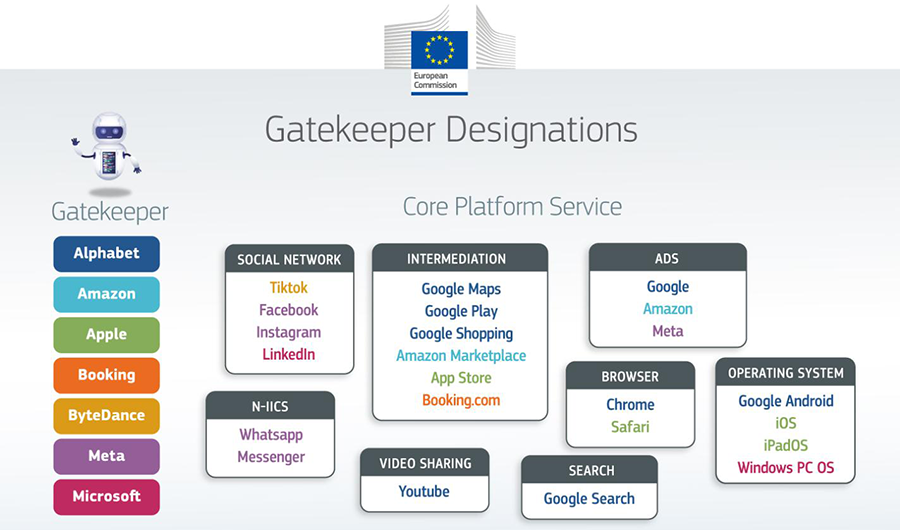
Regulatory pressure has seen Apple move away from the proprietary Apple Wireless Direct Link protocol used by AirDrop to technology based on Wi-Fi Aware, also known as Neighbor Awareness Networking. Wi-Fi Aware is an open standard, developed by the Wi-Fi Alliance, and is now implemented for AirDrop on the iPhone 12 and later models.
In line with the DMA’s regulatory requirements, Apple has also eased controls over multiple features, such as opening NFC to third-party developers, adopting Rich Communication Services messaging in iOS 18 onward, allowing users to side-load apps and uninstall pre-installed apps, and making further changes to iOS, the App Store and the Safari browser. These changes follow the EU’s previous USB-C regulation, which mandated that electronic devices sold in the region must feature USB-C ports to reduce waste and standardize charging. Apple switched from proprietary Lightning connectors to USB-C in 2023.
Apple is the only major smartphone player in the EU’s group of gatekeepers, and although mandates are confined to Europe, their impact is wider, with regulators in other regions watching closely. Furthermore, strong regional regulations influence global standards, as seen with USB-C, Europe’s data privacy rules and now the Wi-Fi Aware standard. It is also easier for manufacturers to adopt standard features, as region-specific exclusivity can be expensive or impractical.
Although expanding existing features to Android will make device interaction easier for both Android and iOS owners, it is unlikely to convince Apple users to switch. Apple’s playbook extends beyond its ecosystem and rests on its premium brand positioning, which has been critical to its success. Apple remains an aspirational brand, and consumer purchase decisions are often driven more by the appeal of a brand and its ecosystem than by individual features. Apple’s strength is complemented by the strong residual value of iPhones, which encourages retention and upgrades.
Despite challenges to its long-established closed ecosystem, Apple has remained resilient. It has invested heavily in custom silicon, expanded its product portfolio, announced improvements to Apple Intelligence, and placed a renewed focus on business users.
That resilience is reflected in Apple’s strong performance in 2025. Sales of 241 million iPhones, up 7%, signal unparalleled brand loyalty. However, regulatory changes will continue to pressure Apple to relax its closed ecosystem — it recently allowed iPhones to pair with and forward notifications to non-Apple wearables, for example.
We expect Apple to continue building new, distinctive integrations. Despite regulatory pressure, Apple continues to evolve, notably by rolling out smartphones with its own silicon, expanding its portfolio to lower price points with products such as the iPhone 17e and MacBook Neo, partnering with Google for Siri integration, and focusing on the business market with its upcoming all-in-one service, Apple Business.
On this basis, it remains a formidable competitor to the Android smartphone ecosystem, despite regulatory-fuelled pressure to open features such as AirDrop.

 LinkedIn
 Email
Email
 Facebook
 X
X