
Why the 6 GHz Band Needs to Be Deployed for Mobile Services Now
Having access to large quantities of wireless spectrum capacity is essential to support large numbers of mobile users. Without sufficient capacity, networks become congested, speeds and error rates worsen, and users complain. But finding new spectrum that’s available globally is becoming increasingly difficult.
The 6 GHz band is critical because it’s high capacity, already available and suppliers are ready to go. It has already been allocated for mobile use in most countries. This provides equipment makers with a large market opportunity and significant economies of scale. The upper 6 GHz band was aligned for telecom use at the 2023 World Telecommunications Conference (WRC-23), and the lower part of the 6 GHz band is also available for mobile use in some countries.
Alternatives to 6 GHz Aren’t Ready Yet
In time, other bands may become available, such as the 4 GHz and 7 to 8 GHz ranges, but they’re yet to be allocated for mobile use and, in many parts of the world, have non-telecom users that would need to be migrated to other bands. Decisions about such bands won’t be made until WRC-27, which is scheduled to happen in late 2027 in Shanghai. Only then could the transition for existing users happen, which is likely to take several years.
Support for the 4.4 to 4.8 GHz band is uncertain in Europe and the Americas because of the presence of incumbent services and its use is a study item for WRC-27. The 7.125 to 8.4 GHz band is a leading spectrum range for future 6G services because there’s potentially 1.275 GHz of contiguous spectrum available. Europe is a key supporter and markets in Asia–Pacific are also investigating its use. But in the Americas, incumbent federal users, government systems and satellite services are present in parts of the band. Regardless, it’ll take at least a few years for this spectrum to be available for use.
The 6 GHz band has a major advantage: it’s available now. But regulators must ensure that they’ve completed any necessary administrative paperwork and can’t afford to procrastinate because of the urgent needs of mobile users.
How AI Will Change Mobile Data Traffic
New spectrum is needed now to keep pace with rising data traffic. All industry forecasts agree that traffic is continuing to rise quickly, even if the rate of increase has started to slow. For example, Ericsson forecasts global wireless data traffic will increase by 2.4 times between 2025 and 2031 with a compound annual growth rate (CAGR) of 16%. Nokia’s base “moderate” consumer forecast, which notably excludes fixed wireless access, estimates a CAGR of 15% between 2024 and 2034, but its “aggressive” forecast is higher than Ericsson’s, with a CAGR of 18%.
Mobile data traffic increases are in part because usage is now going “beyond the smartphone”. Fixed wireless access comprises a large part of 5G data usage because households and small business users with many shared devices transmit more data than does a smartphone. AI is also threatening to change the requirements for mobile networks in several ways.
Visual AI, where smart glasses use on-board cameras to interpret the world, places greater demands on the uplink connection. Connected cars have similar needs. The still images and video streams from such devices generate a lot of data traffic, more as the quality of the media increases with higher-megapixel cameras and video streams that shift from standard dynamic range (SDR) colour with full high definition (HD) resolution to high dynamic range (HDR) colour and 4K.
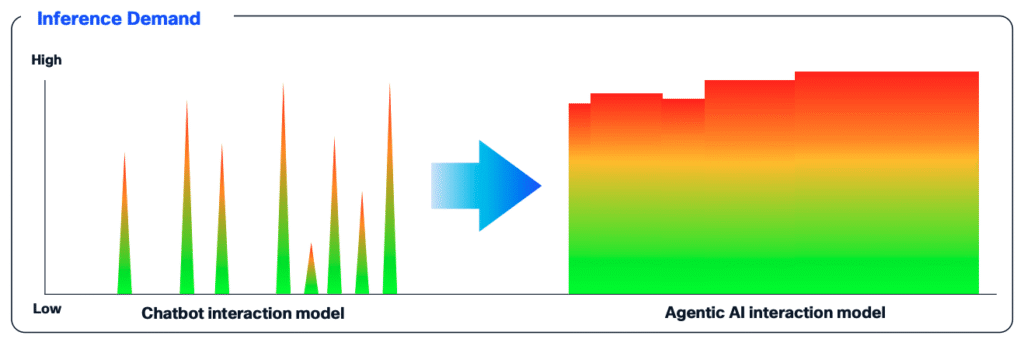
Agentic AI is also starting to place new demands on networks. Already, leading network suppliers report that generative AI is leading to more bursty data traffic where lower latency responsiveness and the speed of the uplink connection is more important than it is for traditional mobile apps. In the future, agents will start to autonomously use the network without users initiating it. This may cause an acceleration of network data traffic as agents in effect become direct mobile users, shown below.
The 6 GHz Ecosystem Is Ready to Go
The world isn’t waiting for 6G mobile services to start in 2029. While 6G will be AI-native on day one and will have integrated support for non-terrestrial networks and integrated sensing and communication (ISAC), already operators are deploying 6G-type services on 5G standalone and 5G-Advanced networks. AI applications are already in wide usage now, new device types such as smart glasses are arriving, operators are offering smartphone satellite connectivity, usage of fixed wireless access is growing and early network sensing technology has been deployed to help airports to detect flocks of birds or drones.
The industry needs new spectrum now for 5G that will also support 6G in the future. The 6 GHz band is the essential new spectrum that can support users today. In March 2026, the GSMA and leading suppliers including major mobile device chipset and network makers announced the readiness of the industry to offer commercial services using the upper 6 GHz band.
In June 2026 at MWC Shanghai, the GSMA’s head of spectrum Luciana Camargos explained the importance of regulators moving to release 6 GHz spectrum that has already been allocated. She said, “it’s very important that regulators set up road maps for the release of spectrum. Mobile operators pay a lot of money for spectrum. They need to plan their investments. They need to plan their networks. For the entire ecosystem, for the entire industry, it’s very important to have a clear signal that the band is now ready for the market-based decisions to be taken by countries”.
Camargos also pointed to the importance of 6 GHz for the few countries that are yet to allocate 6 GHz for mobile services: “There are two elements that will be relevant for upper 6 GHz at WRC-27, which coincidentally will be in Shanghai next year. First, there’s an opportunity for countries that have not joined the upper 6 GHz footnote to do so, particularly in the Americas and Asia–Pacific, they have an opportunity to do that”.
Mobile Services Have Won the 6 GHz Debate Over Wi-Fi’s Backers
Globally, most markets have allocated the upper 6 GHz range for mobile, leaving the lower part of the spectrum for unlicensed use, such as Wi-Fi. However, there are markets in the Americas that have chosen to allocate the 6 GHz range entirely for unlicensed use, including the US. This will place US wireless operators in a very challenging position in the years ahead as mobile data traffic increases. Notably, Brazil, which is in the same ITU region as the US, has recently changed its previous view on 6 GHz and now plans to allocate some of the band for cellular use.
The debate between Wi-Fi proponents and mobile telecom for the 6 GHz band has been fierce in recent years. A striking development was the move by 12 leading European telecom operators in May 2025. Most of these operators have fixed broadband services that need Wi-Fi to share fibre connections through homes and businesses as well as mobile operator businesses. But the 12 firms, shown below, aligned to argue that the upper 6 GHz band should be allocated to mobile services, not Wi-Fi.
In the future, it’s possible that dynamic network sharing might be possible between Wi-Fi and cellular standards. With 6G, there will be a major advance with multi-RAT spectrum sharing (MRSS) that will enable such coexistence between 5G and 6G, making it considerably easier for operators to deploy 6G services. Unlike the dynamic spectrum sharing used for 4G and 5G, MRSS has little capacity overhead.
Such dynamic sharing between Wi-Fi and 5G or 6G isn’t available now and won’t be for many years, if ever. The Wi-Fi Alliance should prioritize the necessary standards development on network radio sharing to avoid future debates over spectrum bands between the mobile telecom industry and Wi-Fi supporters.
Operators and regulators had to decide between the competing interests. At WRC-23, stakeholders opted to allocate upper 6 GHz to mobile. Many countries went further and allocated all of it to mobile. A few chose to offer it all for Wi-Fi, although some like Brazil are now reconsidering.
With the decision made to use the 6 GHz band for mobile, now is the time to quickly deploy 6 GHz to meet the needs of fixed wireless access services, smartphone users, AI applications and AI agents. Delays on deployment help no one.

 LinkedIn
 Email
Email
 Facebook
 X
X