
Memory Crisis Continues to Challenge Global Smartphone Market: Sales Fall 7% in 2Q26
- Shipments of new smartphones declined 7% in 2Q26 as the ongoing memory shortage led manufacturers to push prices up 13% quarter-on-quarter, weakening consumer demand.
- The organized secondary market for smartphones grew 3% as supply shortages weighed heavily on the market despite rapidly growing demand.
- FDM CCS Insight forecasts the primary market to decline 12% in 2026 as continued price increases in the second half of 2026 soften demand.
- The organized secondary market for smartphones is forecast to grow 9% amid supply constraints.
London, 7 August 2026: Shipments of new smartphones declined by 7% in 2Q26 according to FDM CCS Insight, a leading technology data and insight firm. Rising memory costs continued to push device prices up and dampen consumer demand for the second consecutive quarter. Faced with rising component costs, manufacturers continued to secure supply and build inventory ahead of further increases expected in the second half of the year. The average selling price of smartphones increased 13% sequentially as phone-makers passed on higher costs to consumers and shifted toward more-premium models. FDM CCS Insight forecasts the primary market for smartphones to decline by 12% in 2026.
Ben Hatton, Analyst at FDM CCS Insight, commented, “The first half of the year proved more resilient than expected. However, we remain cautious about the second half, as further price increases and prolonged memory shortages — which we expect until 2028 — will continue to raise device prices and soften consumer demand”.
Apple was the only major manufacturer to maintain stable pricing in the first half of the year but is likely to follow its competitors by raising prices in the coming months. The North American and European markets declined by low single-digit percentages, driven by resilient demand for premium smartphones. Emerging markets recorded stronger declines as price-sensitive segments faced aggressive price increases, forcing consumers to delay purchases or seek refurbished alternatives.
Ekta Mittal, Senior Analyst at FDM CCS Insight, added, “A narrowing price gap between Android and iOS has created an opportunity for Apple to attract users who were previously priced out of its ecosystem. At the same time, limited availability of entry-level smartphones in the primary market is accelerating the trend toward more-premium models. Consumers are paying more for lower-specification devices than previous-generation models at similar prices. As affordability comes under pressure, financing, leasing and buyback programmes will be crucial for long-term adoption and to drive upgrades”.
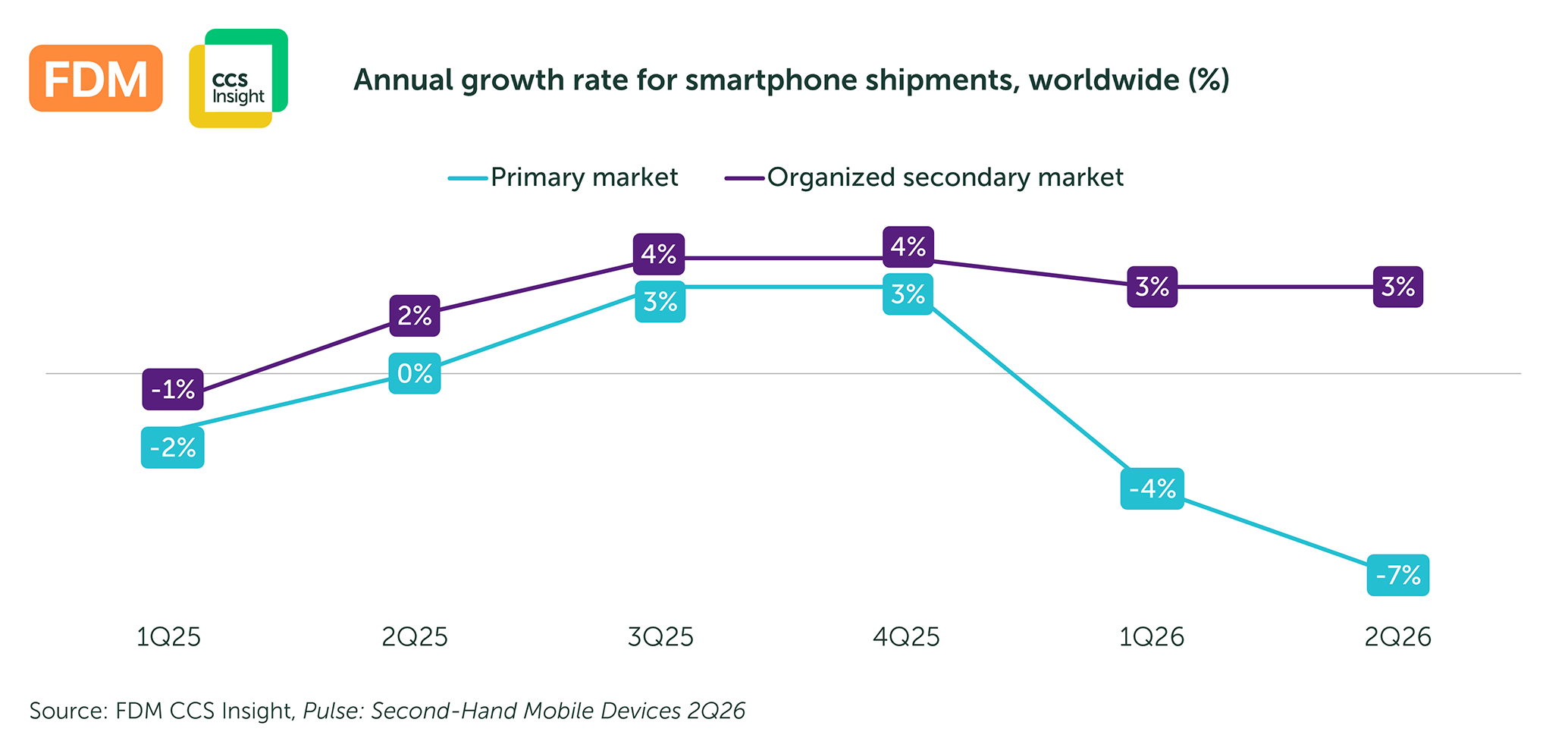
The organized secondary market is the segment of the second-hand smartphone market in which participants add value to the devices they handle, such as through refurbishment, data wiping and warranty support. It grew 3% compared with 2Q25, as weakness in the primary market and supply shortages restricted growth in many regions, gradually pushing up prices of refurbished smartphones. The US continued to scale back trade-in requirements for smartphone upgrades, reducing the supply of devices entering the secondary market. In contrast, exports from China and Japan remained strong, partially offsetting the decline in supply from the US.
Most emerging markets posted healthy growth in the organized secondary market, but countries with import restrictions on used smartphones faced supply constraints, limiting the availability of refurbished devices. The organized secondary market is forecast to grow 9% in 2026, lower than previously expected as supply shortages continue to constrain growth.
Hatton concluded, “The opportunity for the secondary market remains immense. As new devices become progressively more expensive, a growing number of consumers will seek alternatives in the secondary market. Increased participation by major phone-makers is boosting consumer confidence and trust in this space. Improving trade-in programmes is critical for all competitors in the sector to meet growing demand”.
FDM CCS Insight tracks the global connected devices market in a quarterly Pulse dashboard. The latest update with 2Q26 data is available now; contact FDM CCS Insight for more information.
Notes to Editors
FDM CCS Insight’s Pulse dashboard presents findings from original research, with this latest update conducted between July and August 2026. The methodology includes sell-out data provided by more than 40 market participants, senior-level discussions to complete channel and country market sizes and price scraping of major players in the market.
The dashboard explores the overall market for mobile devices, including primary and secondary markets for smartphones, smartwatches, tablets and laptops. It specifically zooms in on the organized secondary segment, presenting analysis of device models, features, brand metrics and more.
More details of FDM CCS Insight’s extensive research into connected devices can be found at https://www.ccsinsight.com/ccs-insight/research-areas/connected-devices/
About FDM CCS Insight
FDM CCS Insight is uniquely positioned to deliver market-leading data with trusted analyst insight, offering technology clients the context, foresight and confidence needed to shape strategy and drive growth. Backed by private equity firm Inflexion, FDM CCS Insight’s analysis is powered by industry-leading point-of-sale datasets. These provide an exceptionally accurate view of telecom market share and brand performance, enabling clients to optimize product portfolios, stay ahead of market fluctuations and drive sales efficiency.
Media Contact
FDM CCS Insight Media Relations: emma.bluck@ccsinsight.com